 Ultimate guide
Procurement Strategies for Long-Term Care Facilities
Quick Summary
Effective procurement strategies for long term care centralize purchasing under one owner, pair it with shared inventory visibility, and manage recurring supplies as a system rather than emergency orders. Each supply category gets its own standard, reorder point, and care-outcome metric. This prevents stockouts and keeps the budget under control.
- Centralize purchasing so one team owns supply orders across the whole facility.
- Pull twelve months of usage data by category and unit before negotiating with suppliers.
- Set par levels from actual usage and review them quarterly to prevent stockouts.
- Score vendors on identical product baskets, delivery performance and documentation.
- Track price variance alongside stockout rate and skin or care outcomes, not price alone.
Table of Contents
- Why Procurement Matters for Long-Term Care Facilities
- Centralized Purchasing and Demand Aggregation
- Long-Term Care Procurement Best Practices by Category
- Medical Supply Vendor Evaluation: A Step-by-Step Process
- Long-Term Care Inventory Management and Stockout Prevention
- Measuring Medical Procurement ROI and Performance KPIs
- Building Your Procurement Plan: Next Steps for Your Facility
- Frequently Asked Questions
Why Procurement Matters for Long-Term Care Facilities
Last Updated: November 1, 2026
Sound procurement strategies for long-term care facilities determine whether residents get the incontinence products, wound care supplies and skin care they need, and whether the budget survives the year.
Long-term care buying differs from hospital buying.
Effective procurement strategies for long term care treat these recurring supplies as a managed system rather than a series of emergency orders.
Centralized Purchasing and Demand Aggregation
Centralized purchasing means one team or one person owns supply orders across the facility, instead of each unit ordering independently. Consolidated demand gives you more leverage when negotiating price and terms, and it reduces the number of small, overpriced orders that accumulate across departments. Learn more cost-reduction steps beyond aggregation for lowering medical supply spend.
Demand aggregation goes a step further. Before you negotiate, pull twelve months of usage data by category and by unit to see which items are consumed predictably, which spike seasonally, and where waste hides.
A common mistake is centralizing purchasing without centralizing inventory visibility. If the buyer cannot see what is on the shelves, you over-order products already in storage.
Long-Term Care Procurement Best Practices by Category
Each supply category has a different demand pattern, risk profile, and consequence if it runs short, so one purchasing rule does not fit all. Group your spend into categories and set a standard for each: reorder point, preferred product or service level, review cadence, and the resident-care outcome it protects. The categories below cover the bulk of recurring long-term care spend.
Medications and Pharmacy Supplies
Medication purchasing in long-term care is shaped by formulary control and the need to avoid interruptions for residents on chronic therapies. Standardize on a preferred formulary where clinically appropriate, track turnaround times for new orders and refills, and set a process for after-hours supply. The metric that matters most is order cycle time and the rate of missed or delayed doses attributable to supply, not unit price.
Medical Supplies and Wound Care
Wound care supplies are lower volume but higher consequence. Barrier products protect periwound skin from adhesive stripping, friction, and moisture. The Medline SurePrep Rapid Dry Barrier Film Wand is a non-stinging, alcohol-free barrier film, and the Medline Remedy Nourishing Skin Cream is a nourishing skin cream. Keep these on a par-level system so they are never out when needed.
Incontinence and Skin Care Supplies
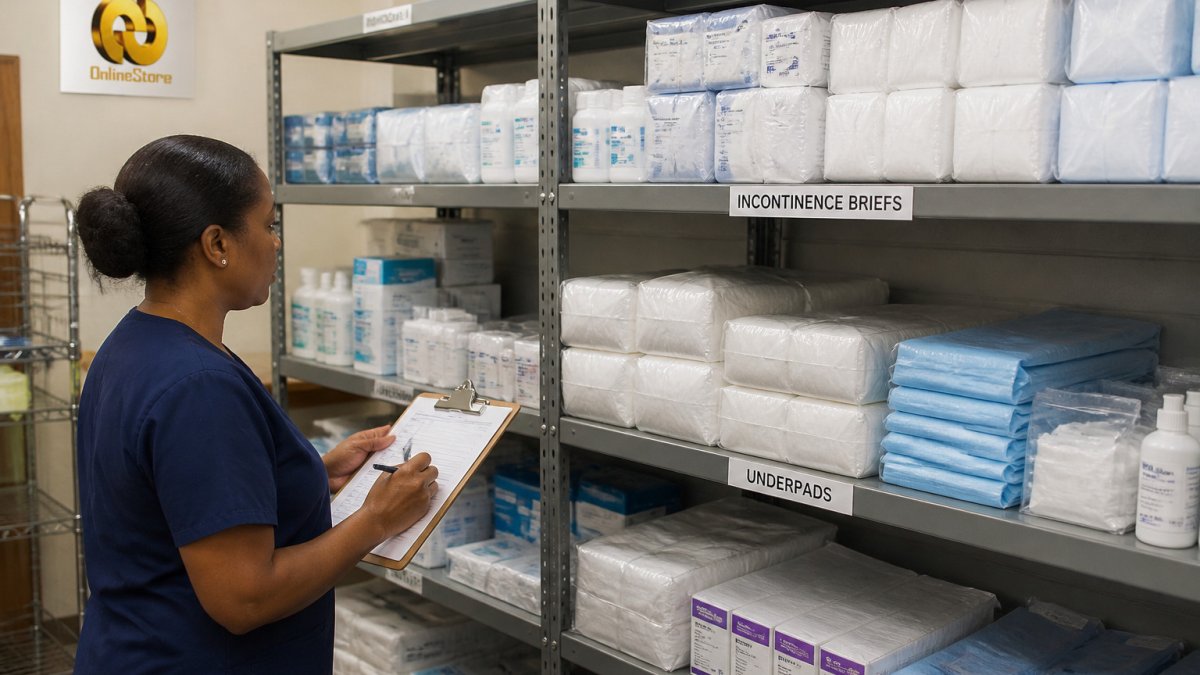
Incontinence products are among the highest-volume items in long-term care, so they deserve the most attention. Standardizing on a small number of products by absorbency level reduces SKU count and simplifies staff training. The Prevail Per-Fit Adult Briefs - Maximum Absorbency are designed for heavy bladder leakage, and the Attends Dri-Sorb Underpads are available for everyday use in hospitals, long-term care facilities, and the home.
Food, Nutrition, and Dietary Supplies
Food and dietary supplies are often purchased through a separate distributor or group purchasing organization, so they can fall outside the procurement review. Bring them into the same governance: standardize on a core menu cycle, track resident-specific texture-modified and thickened-liquid requirements, and set par levels for high-use items. Measure late or substituted deliveries against the dietary orders they affect, and review food purchasing for the labor and waste created by frequent small orders, not just price per case.
Hygiene, Housekeeping, and Infection Control
Hygiene and infection-control products (gloves, disinfectants, hand hygiene, laundry supplies) are consumed continuously and tied directly to infection rates. Standardize on products compatible with your infection-control protocols, confirm disinfectant contact times match staff workflow, and set par levels by unit. Track stockouts of gloves and disinfectants as a patient-safety event, not an inventory inconvenience.
Equipment and Durable Medical Equipment
Equipment purchasing (beds, lifts, wheelchairs, pressure-relief surfaces) is infrequent but high-value, so evaluate it on total cost of ownership rather than unit price. Factor in maintenance contracts, spare parts availability, staff training, and downtime cost when a lift or specialty surface is out of service. For rented equipment, review utilization and return processes so you are not paying for items sitting unused in storage.
Facility Services
Facility services (laundry, waste, pest control, maintenance) are contracted rather than stocked, so procurement here means service-level agreements. Define response times, escalation paths, and performance credits in the contract, and review performance quarterly with the same discipline you apply to product suppliers. A low-cost laundry contract that returns linens late creates a downstream supply problem on the units.
Setting Category Standards
For each category, document four things: the preferred product or service level, the reorder point or service trigger, the review cadence (monthly for high-volume, quarterly for low-volume), and the care outcome metric. This gives buyers a repeatable standard and clinical staff a way to flag when a purchasing decision is creating a care problem. Review the full category list annually and whenever a supplier, regulation, or resident population changes materially.
Medical Supply Vendor Evaluation: A Step-by-Step Process
Choosing a supplier is not a one-time decision. Use a repeatable process so every vendor is judged on the same criteria. Read how to switch vendors without disrupting care if you are moving to a new supplier.
Prevail Per-Fit Adult Briefs - Maximum Absorbency →
- Define your requirements by category. List the products, delivery frequency and minimum order sizes you need for each supply group.
- Request pricing on the same item list. Compare suppliers on identical baskets of products, not on headline discounts.
- Check delivery performance. Ask for on-time delivery rates and what happens when an order is short or late.
- Verify product documentation. Confirm that products meet the regulatory and quality standards your facility must follow, and request the documentation in writing.
- Assess integration and ordering. Find out whether the supplier can work with your existing ordering or inventory process.
- Run a limited pilot. Move one category to the new supplier for a defined period before committing the full account.
- Review at fixed intervals. Reassess performance every quarter against the criteria you set in step one.
When switching vendors, plan the transition so current stock is used up in parallel with the new supplier's first deliveries, preventing the gap that disrupts care.
Long-Term Care Inventory Management and Stockout Prevention
Stockouts in long-term care are not an inconvenience: staff improvise with the wrong product or residents go without basic care.
Set par levels from actual usage data, add a safety margin for delivery lead time, and review them quarterly.
Watch out: par levels set once and never revisited drift away from real consumption, and the first sign is an empty shelf during a busy shift.
Measuring Medical Procurement ROI and Performance KPIs
A procurement program needs measures to show whether it is working, but most long-term care facilities either track nothing or track a long list no one reviews. The practical approach is a small scorecard, reviewed monthly, with each metric tied to a data source you already have and a decision it will trigger.
The Core Scorecard
Track these six metrics consistently. For each, record the baseline before you change anything, so improvement is visible.
- Purchase-price variance: the difference between what you paid and the contracted or benchmark price for the same item. Data source: invoices versus contract price list. Decision it triggers: renegotiate or switch supplier when variance persists above your tolerance for two consecutive months.
- Stockout rate: the share of par-level items that hit zero before reorder during a period. Data source: weekly shelf counts or inventory system. Decision it triggers: raise par level, change reorder point, or add a backup supplier for the affected category.
- Inventory turnover: how quickly stock is consumed relative to how much is held, calculated as cost of goods used divided by average inventory value. Data source: purchasing records and periodic counts. Decision it triggers: reduce over-ordering or free up storage for fast movers.
Calculating Procurement ROI
Calculate procurement ROI by comparing the total cost of your purchasing program against the savings and avoided costs it produces. Include staff time spent on purchasing, transition or implementation costs, and the cost of holding inventory. On the benefit side, count price savings against baseline, reduced emergency or off-contract purchases, and the value of avoided stockouts (staff time lost to sourcing, and care disruptions).
Setting Targets and Review Cadence
Set targets from your own baseline rather than unverifiable industry benchmarks. A common pattern is steady month-over-month improvement in variance and stockout rate, with contract compliance as a threshold metric that should stay high once reached. Review the scorecard monthly with operations and clinical leads, and do a deeper quarterly review of supplier performance and category standards.
| Procurement Area | Key Action | Measure of Success | Review Cadence |
|---|---|---|---|
| Purchasing | Consolidate orders centrally | Purchase-price variance; contract compliance | Monthly |
| Vendor selection | Score suppliers on the same criteria | On-time and in-full rate; order cycle time | Quarterly |
| Inventory | Set and review par levels | Stockout rate; inventory turnover | Monthly |
| Care linkage | Pair savings with care-outcome metrics | Stockouts affecting care; skin/infection indicators | Monthly |
| Reporting | One-page scorecard review | Trend across all metrics | Monthly |
Making the Data Usable
Most facilities already have the raw data in invoices, receiving logs, and shelf counts; the gap is consolidation. A simple shared spreadsheet updated weekly is enough to start, and it can later be replaced by an inventory or procurement system. Assign one owner for the scorecard, set a fixed review date, and record the decision made at each review so the program builds a history.
Building Your Procurement Plan: Next Steps for Your Facility
Start with the data you already have.
Then sequence the work: centralize purchasing, set par levels for your highest-volume categories, run a structured review of one supplier relationship, and set up the monthly KPI report.
If your facility is ready to review its current supply categories, you can browse our range of incontinence and wound care supplies to compare products against your standards.
Frequently Asked Questions
What are the main procurement strategies for long-term care facilities?
The core strategies are centralized purchasing, which pools demand across sites or departments to improve pricing; standardizing products so staff order fewer SKUs; formal supplier selection and contracts; automated reordering tied to par levels; and regular spend reviews. Facilities that combine these typically gain better price terms and fewer emergency orders. Start with your highest-volume categories such as incontinence and skin care, where consistent replenishment matters most for resident comfort and skin integrity.
How can long-term care facilities reduce supply costs without compromising quality?
Standardize on a smaller set of proven products within each category, then compare unit costs per usable piece rather than per case. Use group purchasing or aggregated orders to negotiate volume pricing, and review spend data monthly to catch price drift. Quality is protected by requiring product specifications and samples before switching, and by tracking complaints or skin-related incidents after any change. Cheaper products are not savings if they increase waste or staff time.
How should a long-term care facility evaluate medical supply vendors?
Score vendors on price transparency, product range across your categories, on-time delivery record, order accuracy, responsiveness to shortages, data security and payment compliance, and clarity about who stands behind the company. Ask for references from similar facilities and request a trial order before committing to a contract. Review performance quarterly and keep a documented fallback supplier for critical items.
What supplies should long-term care facilities keep in inventory?
Keep stock of high-use, chronic-demand items: incontinence products, underpads, barrier creams and cleansers, and wound care supplies. Set par levels based on average weekly usage plus a safety buffer for delivery lead times. Review usage data regularly, because resident mix changes can shift demand quickly, and avoid overstocking slow-moving items that expire or take up storage space.
How can long-term care providers prevent supply shortages?
Track usage by item and department, set reorder points before stock runs low, and use automated ordering where your systems allow it. Maintain a qualified secondary supplier for critical products and check that substitutes are clinically appropriate. Assign one person to own inventory reporting so shortages are flagged early rather than discovered at the point of care.
What is group purchasing, and can it benefit long-term care facilities?
Group purchasing means several facilities or organizations commit to buying together under shared pricing and terms. For smaller long-term care providers, it can deliver volume discounts they could not negotiate alone and reduce the administrative work of managing separate contracts. The trade-off is less control over product choice, so confirm the group contract covers the categories and specifications your residents need before joining.
How do you measure procurement performance in a long-term care facility?
Useful KPIs include purchase-price variance by category, spend per resident day, inventory turnover, stockout frequency, order accuracy, order cycle time and supplier on-time delivery rate. Calculate procurement ROI by comparing savings and efficiency gains against the cost of any new systems or staff time. Review these metrics quarterly and tie them to clear targets so procurement decisions are based on evidence rather than habit.