 blog
blog
What to Look for When Buying Medical Exam Tables 2026
Table of Contents
- Understanding Medical Exam Table Types and Clinical Uses
- Height Adjustment: Manual Versus Powered Options
- ADA-Compliant Examination Tables and Accessibility Standards
- Medical Exam Table Upholstery Materials and Infection Control
- Medical Exam Table Weight Capacity and Frame Stability
- Medical Exam Table Cost and Total Cost of Ownership
- Key Features Comparison and Evaluation Checklist
- Frequently Asked Questions
Last Updated: October 6, 2026
Understanding Medical Exam Table Types and Clinical Uses
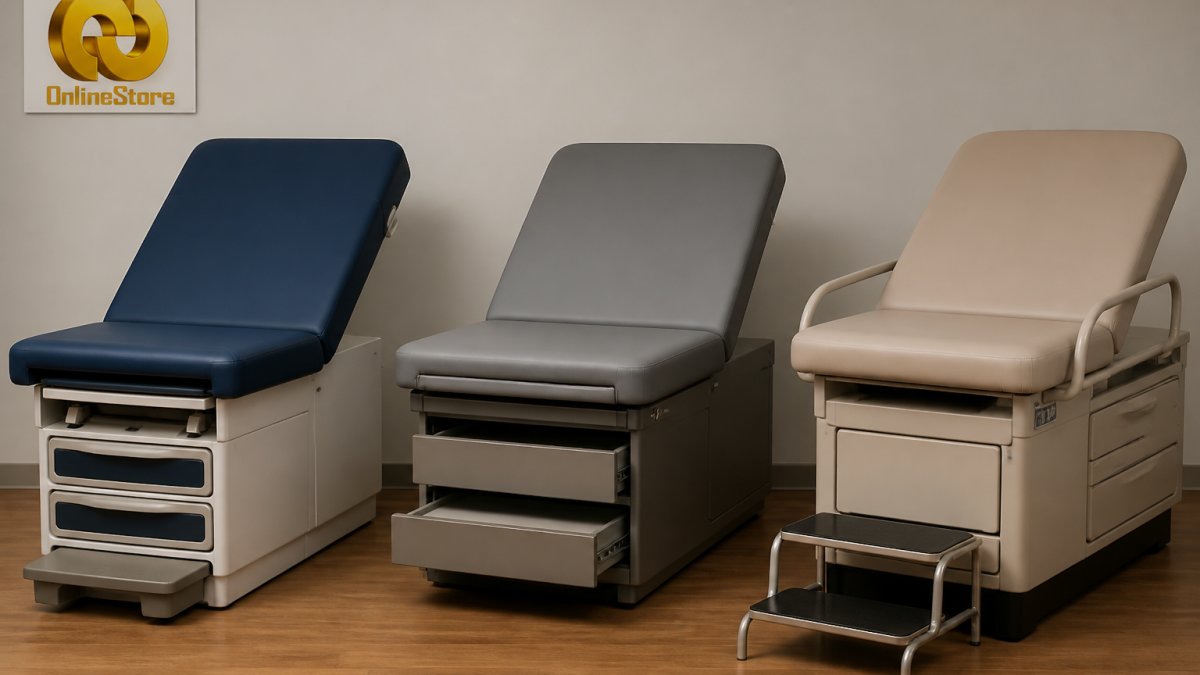
Medical exam tables come in several configurations, each designed for specific clinical workflows: general-purpose examination tables, gynecological tables, pediatric tables, and bariatric models. Matching the type to your patient population is the first step in a smart purchase.
General-purpose examination tables suit primary care, urgent care, and multi-specialty practices, with adjustable backrests and leg sections. Gynecological tables add stirrups and specialized pelvic-exam positioning. Pediatric tables are smaller, with safety rails and colorful designs that reduce anxiety. Bariatric examination tables support 500-600 pounds with reinforced frames for stability.
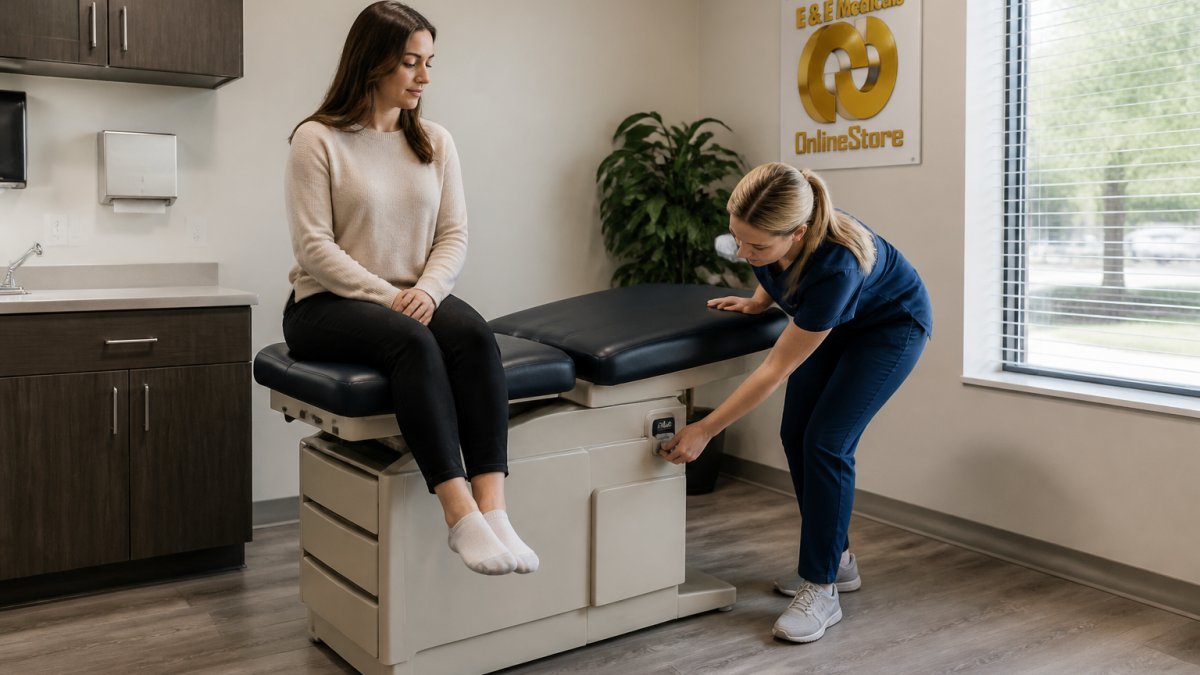
Clinical use case determines which features matter most. A busy primary care office prioritizes quick height adjustment and easy cleaning; dermatology may need specific positioning for lesion exams; long-term care needs tables that simplify transfers and reduce caregiver strain.
Height Adjustment: Manual Versus Powered Options
Height adjustment is one of the most frequently used features on a medical exam table. The choice between manual and powered adjustment directly affects clinical efficiency, staff safety, and patient comfort during transfers.
Manual height adjustment uses a foot pump or hand crank. These tables cost less upfront and need no electrical connection, but demand physical effort from staff who may adjust height dozens of times daily, and they can slow workflow during peak hours.
Powered height adjustment uses electric motors controlled by buttons or foot pedals, letting staff adjust height smoothly without strain and reducing repetitive stress injuries. Powered tables speed patient transitions in high-volume settings, at the cost of higher upfront price and electrical dependence. Many include memory presets for different exam types.
Choosing manual tables solely to save money upfront is a common mistake: the hidden cost shows up in staff fatigue, slower throughput, and potential injury claims. For practices seeing more than 20 patients daily, powered adjustment typically pays for itself within 3-5 years.
ADA-Compliant Examination Tables and Accessibility Standards
Most buying guides gloss over accessibility, mentioning "ADA compliance" without saying what to measure. For a 2026 purchase, treat accessibility as verifiable specifications, not a marketing label.
The relevant U.S. reference points are the ADA Accessibility Guidelines (ADAAG), the 2010 ADA Standards' accessible-design provisions, and the U.S. Access Board's guidance on accessible medical diagnostic equipment. The commonly cited target for an accessible exam table is a low transfer height of roughly 17-19 inches (some clinical guidance allows up to 20 inches for certain transfer scenarios). Confirm the exact figure with your compliance officer, since state and payer requirements differ.
What to actually verify on a spec sheet or demo unit:
- Lowest seat height. The table must lower to the accessible transfer range, not just "low," but a stated number in inches. A powered table that bottoms out at 24 inches is not accessible for many wheelchair users.
- Transfer clearance. Measure the open space on the transfer side. A common planning target is at least 36 inches of clear floor space beside the table for a wheelchair or transfer board, plus room to maneuver on the opposite side. Removable or swing-away armrests and a drop-down side rail open the transfer path.
- Mobility-device compatibility. Can a standard wheelchair, a bariatric wheelchair, or a scooter approach the table without the base or foot section blocking the approach? Check the base footprint and whether the foot section retracts.
- Stability under lateral load. A transferring patient pushes sideways against the table. Look for a wide base, outriggers, or a low center of gravity, and test with lateral pressure before purchase.
- Grab surfaces. Armrests, side rails, and the table edge should be rated for a patient pulling or pushing during transfer. Ask the manufacturer for the rated load on those components, not just the overall patient weight capacity.
- Height-adjustment controls reachable from a seated position. If the patient or a seated caregiver must adjust height, the control must be reachable without standing.
A practical pre-purchase test: bring a wheelchair or transfer board to the demo and run a transfer with a staff member as the patient. If the transfer requires lifting rather than sliding or stepping, the table is not solving the accessibility problem. This catches more real-world failures than any spec sheet.
Accessibility also pays off in staff safety: tables that support sliding transfers reduce the manual lifting behind caregiver back injuries, one of healthcare's most common workplace injury categories. For practices serving an aging or mobility-limited population, the accessible table is both a compliance requirement and a retention tool.
Medical Exam Table Upholstery Materials and Infection Control
The upholstery you choose determines how effectively you can prevent cross-contamination between patients. This is one area where cost-cutting creates genuine clinical risk.
Vinyl upholstery is the industry standard for medical exam tables. It resists fluid penetration, withstands repeated disinfection with alcohol and bleach-based cleaners, and tears less easily than fabric.
Foam cushioning underneath the vinyl matters more than many practices realize. High-density foam resists compression and maintains support; low-density foam compresses over time, creating uneven surfaces that affect positioning and look worn within months.
Between-appointment cleaning depends on upholstery choice. Vinyl tables need only a wipe-down with hospital-grade disinfectant, quaternary ammonium compounds or bleach solutions both work well on quality vinyl.
A critical detail many overlook: seams and stitching are contamination vectors. Welded seams eliminate the gaps where bacteria accumulate, so examine seams closely when evaluating upholstery. Welded construction costs slightly more but provides superior infection control over the table's service life.
Medical Exam Table Weight Capacity and Frame Stability
Weight capacity directly affects patient safety and table longevity. Exceeding a table's rated capacity risks collapse, injuries, and liability exposure. Frame construction determines whether a table maintains stability under real-world use.
Standard examination tables typically support 350-400 pounds, bariatric tables 500-600 pounds, and some orthopedic specialty tables 800 pounds or more.
Frame construction quality varies significantly. Steel frames with welded joints provide superior stability to bolted construction: welded frames eliminate movement at connection points, preventing creaking and maintaining precise positioning, while bolted frames need periodic tightening and can develop play that affects accuracy.
The base footprint affects stability during transfers. Wider bases with outriggers prevent tipping when patients shift weight laterally; a narrow base may meet weight capacity specs but feel unstable in use. That's why hands-on evaluation matters, specifications alone don't capture real-world stability.
Leg section support is often underestimated. When a patient's legs are elevated, weight distribution changes dramatically.
Medical Exam Table Cost and Total Cost of Ownership
Most buying guides stop at purchase price. The transparent way to compare tables is to total every cost over the table's service life, then divide by expected years of service.
The cost buckets to include:
| Cost bucket | What to ask | Why it matters |
|---|---|---|
| Purchase price | Base table plus required accessories | Accessories are often priced separately |
| Delivery and installation | Is freight, liftgate, and setup included? | Can add meaningful cost and delay |
| Electrical work | Does the room need a dedicated circuit or outlet relocation? | Powered tables may require an electrician |
| Consumables | Paper rolls, table covers, disinfectant | Recurring, predictable |
| Preventive maintenance | Lubrication, bolt checks, calibration | Higher on manual and bolted-frame tables |
| Repairs and parts | Availability and lead time for motors, cables, upholstery | Budget tables often have slow, costly parts |
| Upholstery replacement | Expected re-cover interval | Vinyl quality drives this |
| Downtime | Revenue lost while the table is out of service | The hidden cost most buyers ignore |
| Disposal or refurbishment | End-of-life handling | Small but real |
Warranty as a cost signal. Warranty length is the manufacturer's own estimate of how long the table will last without major failure. A 5-7 year frame and mechanical warranty signals a longer expected life than a 1-2 year warranty.
A worked comparison. Suppose Table A costs less upfront but has a 2-year warranty, a bolted frame, and lower-grade vinyl, and you expect to replace it in 5 years.
Refurbished and remanufactured options. A properly reconditioned table from a reputable supplier can deliver similar reliability at lower upfront cost, but only if reconditioning includes new upholstery, tested motors, and a written warranty. Ask what was replaced versus merely cleaned, a refurbished table with original upholstery and untested electronics is a false economy.
Volume and procurement. If you are outfitting multiple exam rooms, ask about multi-unit pricing, consolidated freight, and single-visit installation. These legitimate levers reduce per-table cost without compromising the table itself.
Service life planning. Build a replacement schedule into your capital budget. A table used 20+ times a day reaches end of life sooner than one used a few times a day.
Key Features Comparison and Evaluation Checklist
When comparing medical exam tables, evaluate these features systematically so you're comparing equivalent options across models.
| Feature | What to Look For | Why It Matters |
|---|---|---|
| Height Adjustment | Powered with memory presets vs. manual | Affects workflow speed and staff safety |
| Weight Capacity | 350-600+ lbs depending on patient population | Ensures safety and accommodates diverse patients |
| Backrest Range | 0-90 degrees minimum | Enables multiple exam positions |
| Upholstery | Welded seams, high-density foam, medical-grade vinyl | Improves infection control and durability |
| Base Stability | Wide footprint with outriggers | Prevents tipping during patient transfers |
| Accessories | Paper holder, paper cutter, side rails, stirrups | Improves efficiency and patient positioning |
| Warranty | 5+ years on frame and mechanical components | Reduces long-term repair costs |
| Power Requirements | 110V vs. 220V | Affects installation flexibility |
Use this evaluation checklist before purchasing:
- Confirm weight capacity exceeds your heaviest anticipated patient by 50+ pounds
- Test height adjustment speed and smoothness (both up and down)
- Inspect upholstery seams, confirm they are welded, not stitched
- Check backrest and leg section positioning across full range of motion
- Verify base stability by applying lateral pressure to the table surface
- Confirm all accessories your practice needs are included or available
- Review warranty coverage and available extended warranty options
- Calculate total cost of ownership over expected service life
- Verify electrical requirements match your facility's infrastructure
- Confirm delivery timeline and installation support
This systematic approach prevents purchasing mistakes and ensures your investment matches your practice's actual needs. E&E Medicals and Consulting Inc can help you navigate these specifications and connect you with quality equipment that meets your requirements and budget.
Selecting the right medical exam table requires balancing clinical functionality, patient safety, infection control, and long-term value. The features that matter most depend on your patient population, exam volume, and facility constraints. When you're ready to invest in quality examination equipment, E&E Medicals and Consulting Inc offers professional-grade tables with fast delivery, secure ordering, and pricing designed for healthcare practices managing procurement budgets. Shop to find the right fit for your practice.
Frequently Asked Questions
What are the key features to compare when buying a medical exam table?
Focus on height adjustment method (manual or powered), weight capacity, upholstery material, backrest positioning options, frame durability, and accessibility features. Compare how each table handles patient positioning, infection control through cleanable surfaces, and integration with your exam room layout. Also assess warranty coverage, replacement parts availability, and total cost of ownership rather than purchase price alone.
Are powered medical exam tables worth the extra cost compared to manual adjustment?
Powered tables reduce clinician strain and improve workflow efficiency, especially in high-volume practices. They provide smoother height adjustment and faster patient positioning, which can reduce appointment time and staff fatigue. Manual tables cost less upfront but require more physical effort. The decision depends on your patient volume, staff physical demands, and budget for lifecycle costs including maintenance and repair.
What weight capacity should a medical exam table support for a general practice?
Verify the rated load capacity matches your patient population's needs. Check whether the weight capacity applies to the entire table or just the seat surface, and confirm the frame construction and gas spring systems can sustain that load safely over years of use without degradation.
What upholstery material is best for infection control in exam tables?
Fluid-resistant, non-porous upholstery is essential for infection prevention. Materials like vinyl or polyurethane-coated foam allow quick disinfection between appointments and resist staining from bodily fluids. Avoid cloth or porous cushioning that traps bacteria and cannot be thoroughly cleaned. Check that the upholstery is rated for high-level disinfectants and can withstand frequent cleaning without degradation over the table's service life.